Increased onboarding readiness scores from 51→ 80 by designing a flexible resource model used across 9 teams
-
PROBLEM
New starters experienced inconsistent onboarding depending on team structure, leaving many without the resources needed to work confidently in their first weeks. -
ROLE & CONTEXT
I led the research synthesis, prioritisation and design of an improved onboarding model across nine teams with differing expectations and constraints. -
RESEARCH
Interviews revealed that while onboarding challenges were shared, new starters required different levels of structure and autonomy across four persona types. -
DECISION
I prioritised improving resource delivery through a flexible onboarding model that balanced structure with autonomy. -
SOLUTION
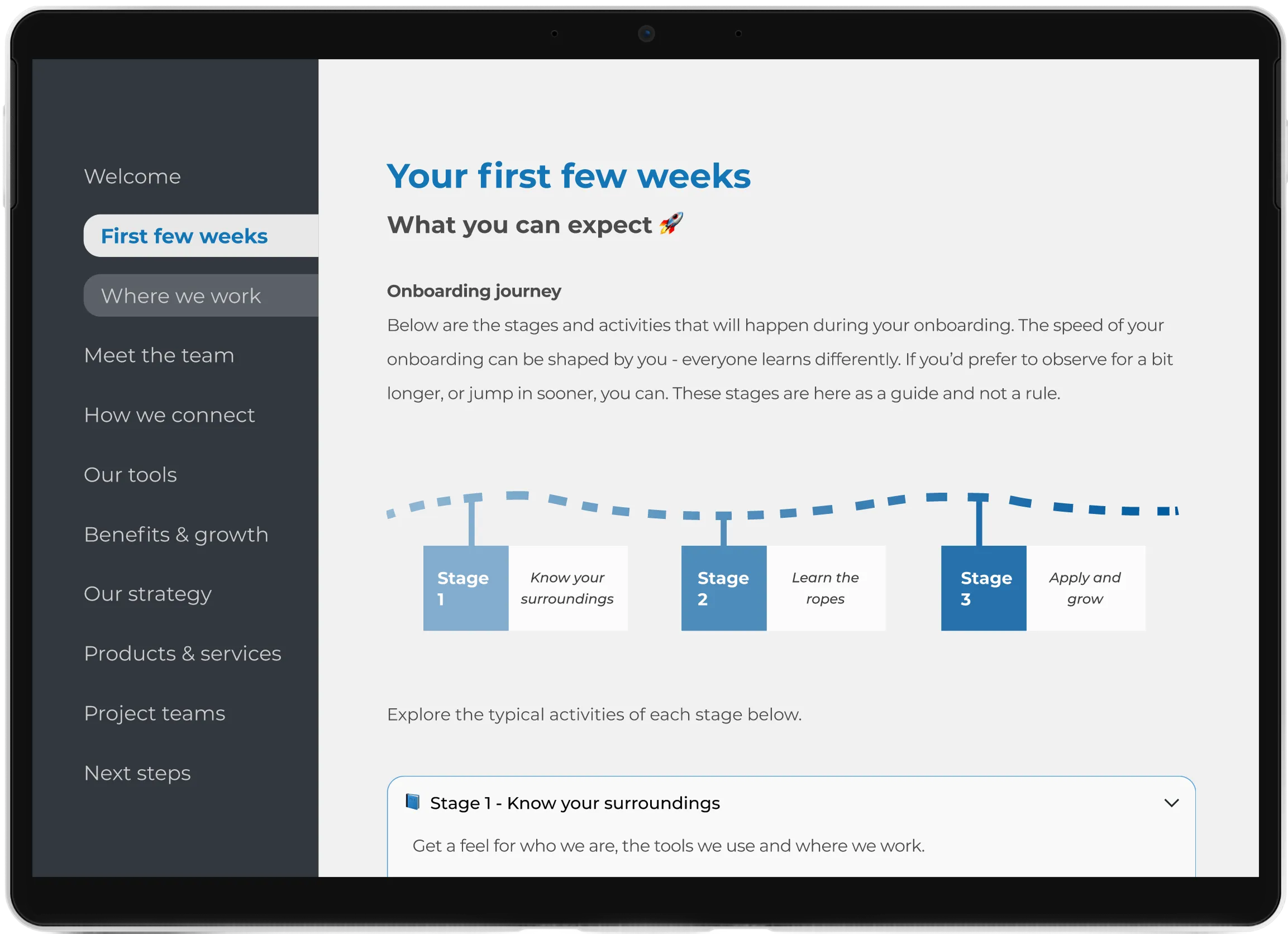
An interactive onboarding guide structured key resources into a flexible, low-friction experience for new starters across teams. -
OUTCOME
The new onboarding model improved clarity for new starters, with a 56% improvement in resource discovery. The template was adopted by 2 additional teams, demonstrating flexibility and relevance.
PROBLEM
Inconsistent onboarding experiences slowed new starter productivity
Onboarding experiences varied significantly across nine teams, creating uneven access to guidance, resources and support. Some new starters received structured onboarding, while others relied on informal help or self-discovery.
Early conversations indicated this inconsistency affected confidence, productivity and clarity in the first weeks. To understand the issue more systematically, I conducted sequential interviews with 10 new starters across six teams.
Four recurring themes emerged:
People & support
Logistics & set-up
Resources & structure
Culture & confidence
While several areas contributed to friction, issues around resource access and onboarding structure consistently delayed new starters’ ability to work independently and be productive. This indicated an opportunity to create a consistent foundation for onboarding.
“I ended up creating a personal FigJam board to map out how everything fits together. It was my workaround as nothing else was in place.”
Lead Service Designer
“I didn’t use the documentation provided… I couldn’t tell what was accurate”
Design System Lead
CONTEXT
The solution balanced structure and 9 teams’ onboarding requirements
I owned the end-to-end design of the onboarding improvement initiative, from research synthesis through to prototyping and validation, reporting back to leadership on progress.
The project involved navigating multiple organisational constraints. Midway through the project, the Director expanded the scope from the Design team to all 9 teams in Digital Delivery & Design. This required the solution to scale across more workflows and onboarding practices.
To manage this complexity, I focused on identifying shared onboarding needs through a discovery workshop, rather than enforcing a fully standardised process.
RESEARCH
Research revealed ‘Resources & Structure’ as the weakest area
Mapping the onboarding journey from pre-start to Week 2 revealed where early friction appeared across resource access. This highlighted that many new starters struggled when guidance wasn’t available, relying on informal support.
Additionally, each onboarding journey was scored against 16 key activities, such as tool access and documentation clarity. “Resources & Structure” emerged as the weakest area, scoring 51/100.
Interviews further showed that new starters differed significantly in how much structure they needed:
Some wanted clear guidance and sequencing
Others preferred quick access to resources so they could move independently
This insight shaped the core design challenge: How might we provide a consistent onboarding foundation without slowing experienced joiners or overwhelming autonomous learners?
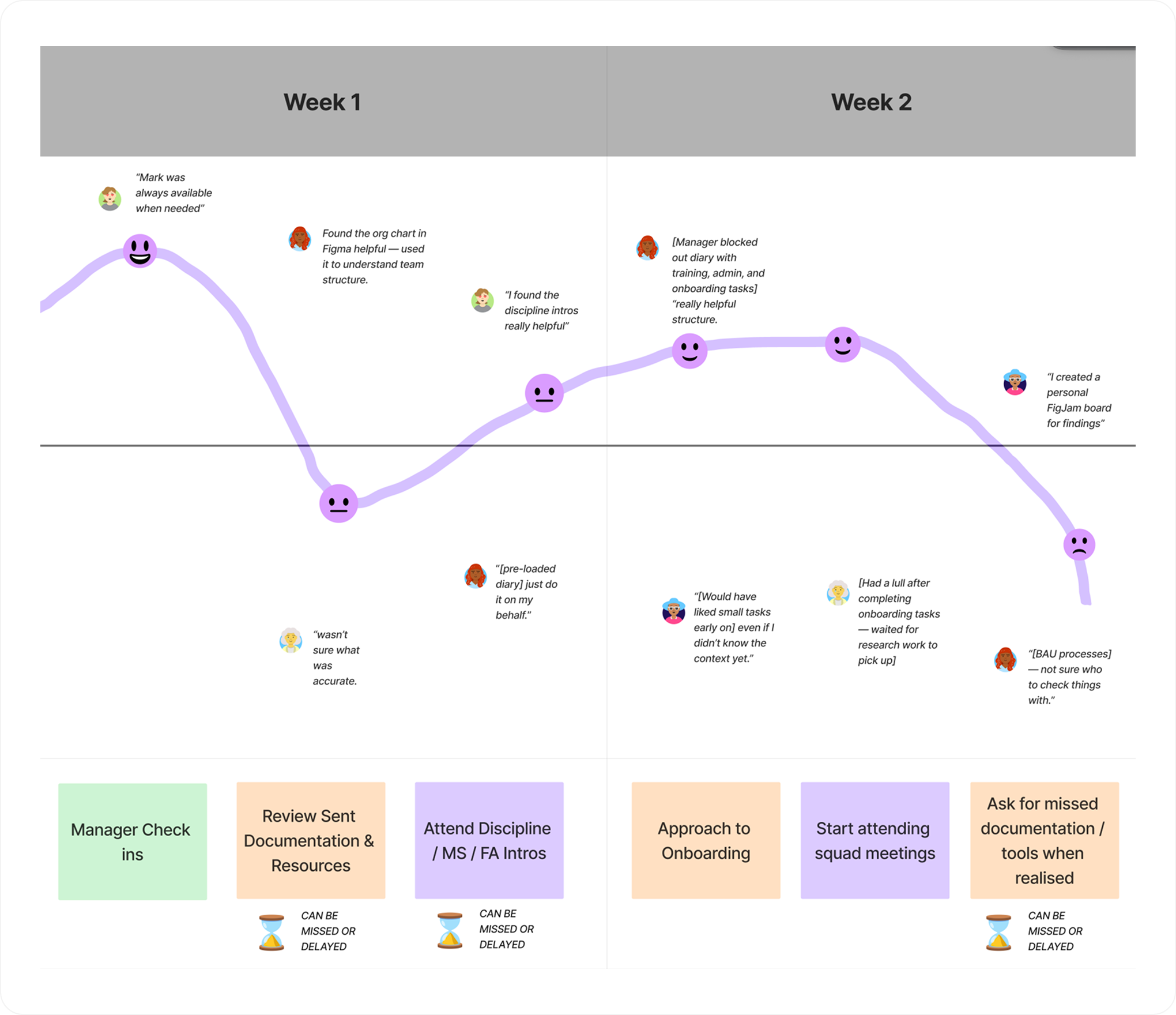
Early onboarding friction clustered around resource discovery, which was shadowed by informal support
DECISION
Different onboarding needs required a model that balanced structure with autonomy
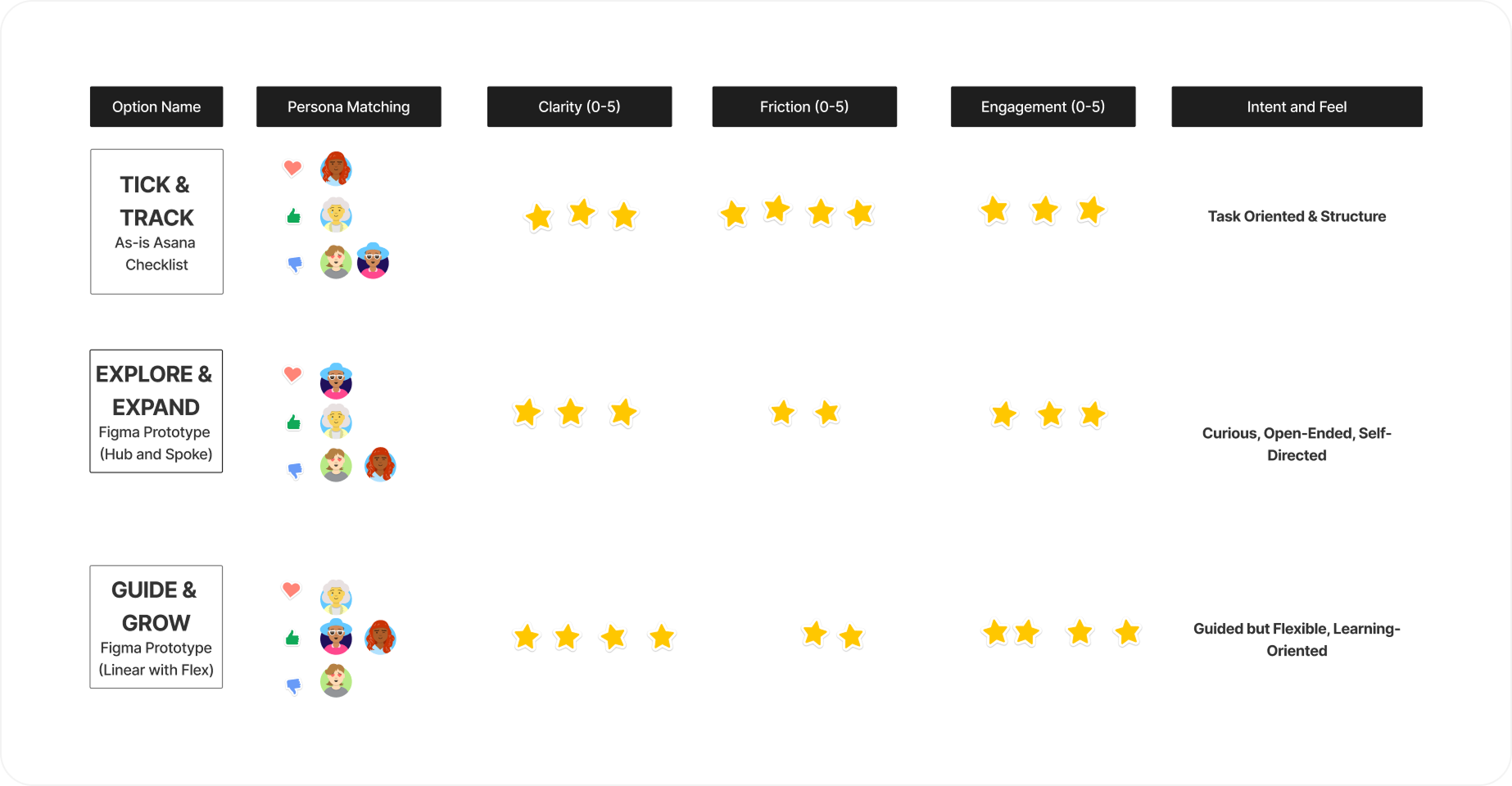
Three potential approaches emerged:
1 Improving the existing personalised onboarding checklist
2 Creating a centralised hub
3 Creating a linear guide
The checklist approach relied heavily on managers remembering to duplicate, personalise and distribute templates, creating friction and inconsistencies.
The resource-model approach offered a more scalable solution by providing a shared foundation while still allowing teams to contextualise content. A linear with flex suited both behaviours: new starters could follow guided steps, while experienced hires could jump to relevant resources.
I therefore pursued a structured but flexible resource guide, designed to support both guided onboarding and self-directed exploration. I built the concept as an interactive Figma prototype, enabling rapid iteration and testing of structure, navigation and engagement.
SOLUTION
A structured but flexible onboarding guide improved resource delivery for new starters
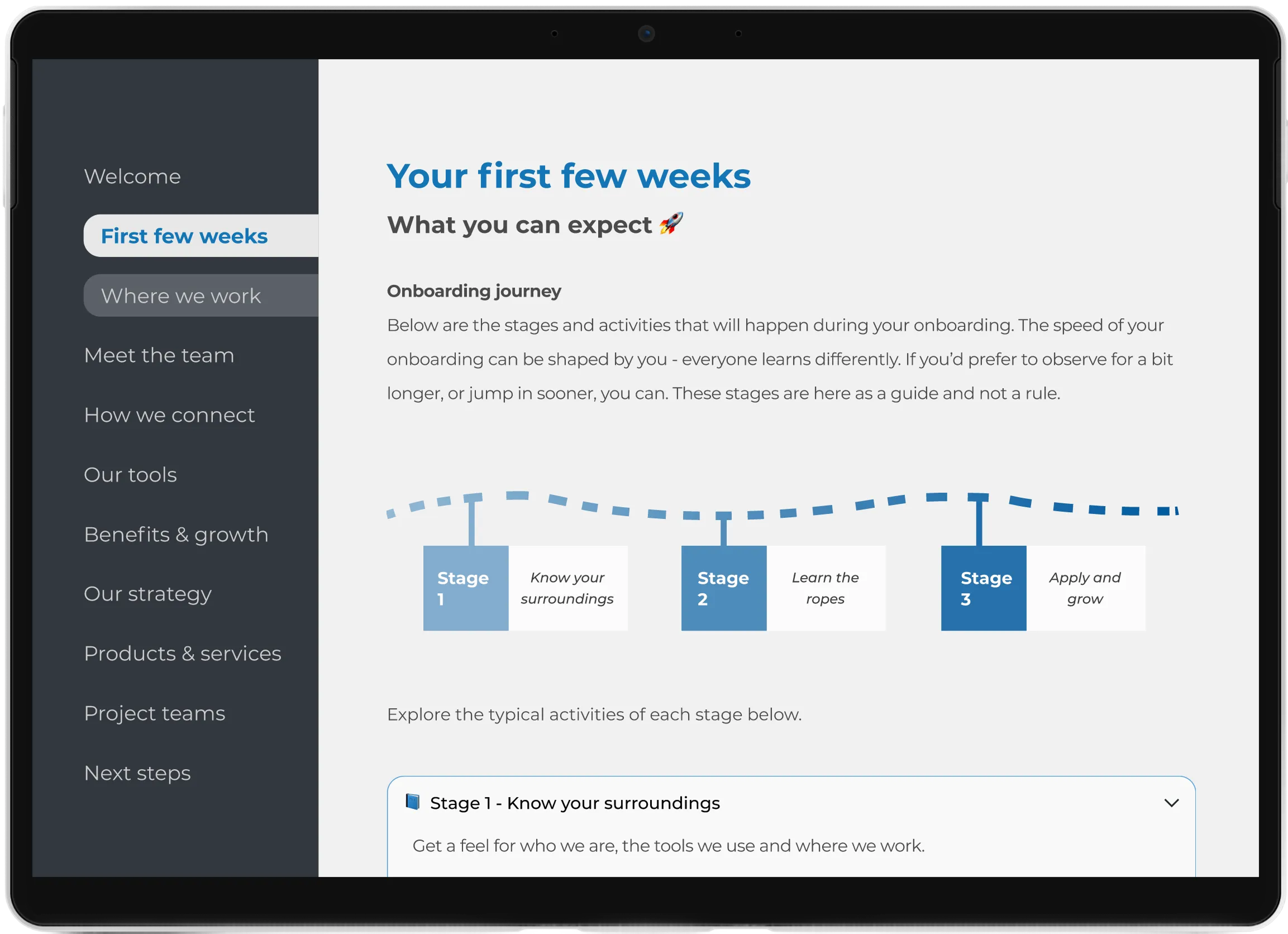
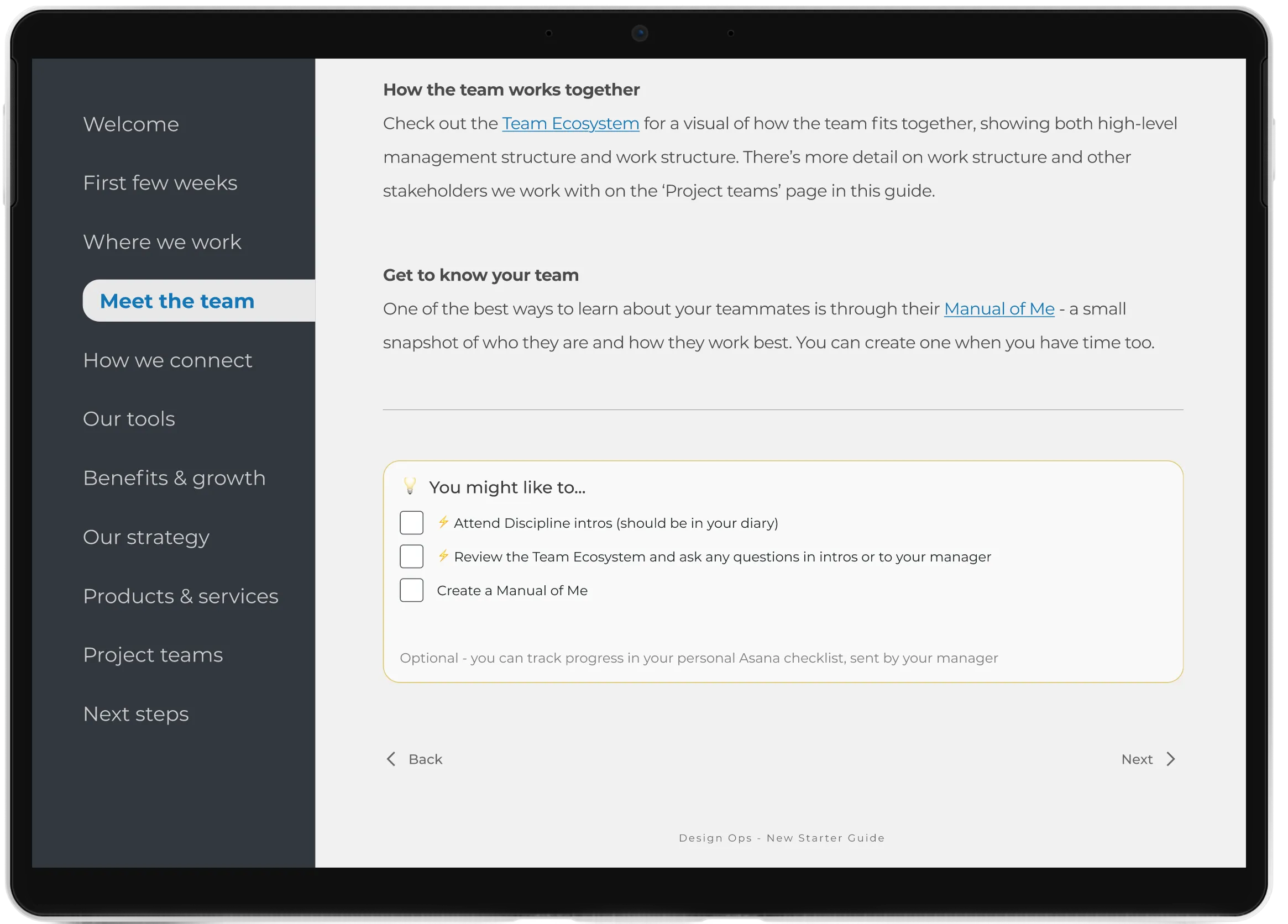
I developed an interactive onboarding guide designed to reduce cognitive load while allowing flexible navigation.
Low-fidelity prototypes allowed me to experiment with structure, pacing and tone, using rapid iteration to test the concept with recent new starters.
Testing confirmed that a “linear with flexibility” model performed better than a hub-and-spoke structure, allowing users to follow suggested onboarding steps while easily revisiting resources.
Key design decisions included:
A minimal entry page establishing tone and clarity
A side navigation to support revisiting resources
Accordions to manage dense or optional content
Checklists to guide suggested onboarding tasks
Accessibility checks for colour contrast and readability
I also collaborated with stakeholders in a resources workshop to identify relevant materials and ensure the guide reflected existing team practices.
IMPACT
New starters reported clearer expectations and understanding
Outcomes
After implementation, I re-evaluated onboarding experiences using the same scoring framework.
The Resources & Structure score improved from 51 to 80, representing a 56% increase in onboarding readiness within the targeted area.
Follow-up interviews with new starters indicated clearer expectations and faster access to key resources.
The onboarding model was also organically adopted by two additional teams (one internal and one external), demonstrating that the structure was flexible enough to adapt across contexts.
Reflections
Designing the guide as an interactive prototype rather than a static document proved valuable for both experimentation and adoption.
Future iterations will focus on addressing remaining resource gaps and establishing clearer ownership and version control to support long-term scalability
Reduced user licence request time from ~5 days to 90 mins
Redesigned the licence request experience by introducing clearer decision guidance, structured request flows and lightweight automation to reduce accidental requests and improve approval speed